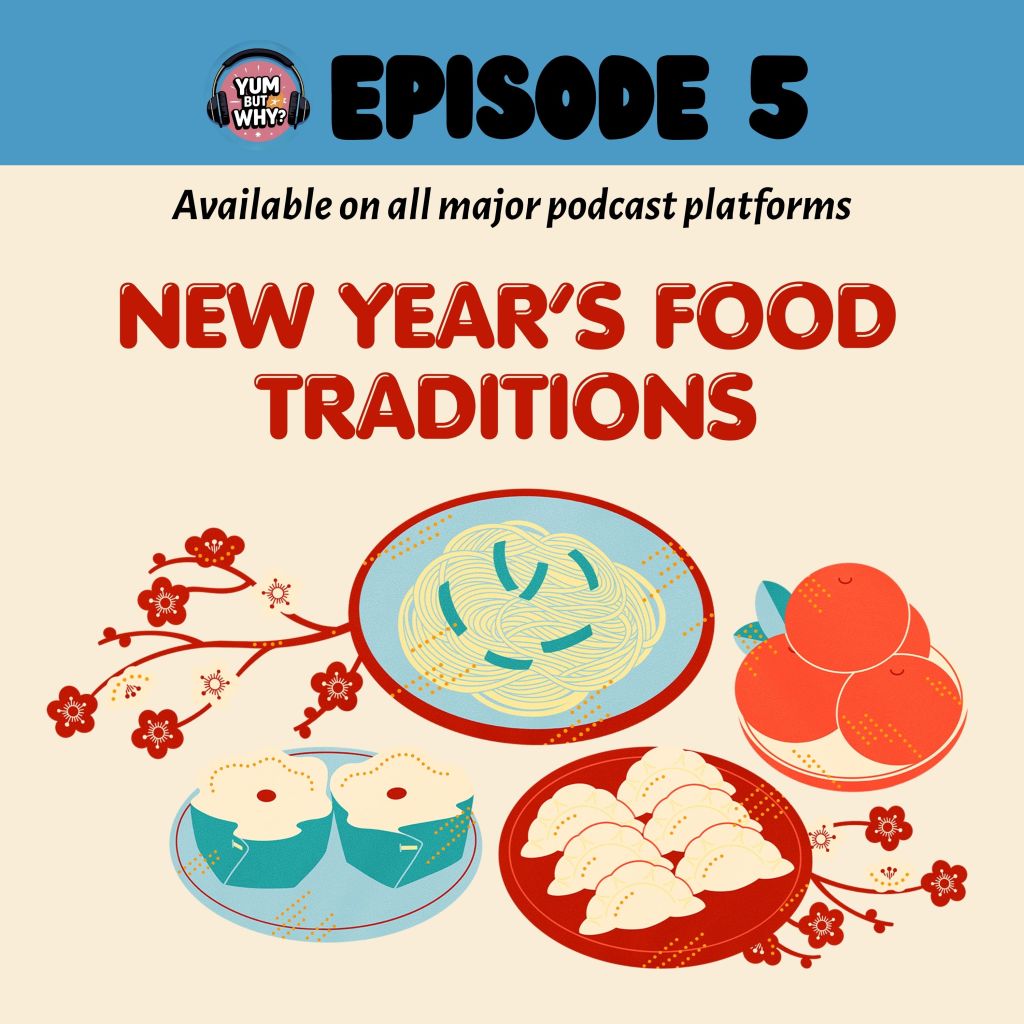
Companion blog post to Episode: “New Year’s Food Traditions Around the World”

Foraging: The Original Grocery Store – Yum But Why?
Happy New Year, Yum But Why listeners! 🎉
We just released our episode exploring New Year’s food traditions from cultures around the globe—from Hoppin’ John in the American South to tamales in Mexico, from toshikoshi soba in Japan to Indigenous first foods ceremonies in the Pacific Northwest. If your family loved learning about these delicious traditions, we’ve gathered resources, books, videos, and activities to help you continue exploring!
🎥 Videos & Online Resources
How to Make Traditional Foods
Making Toshikoshi Soba (Japanese New Year Noodles)
- Just One Cookbook – Nami has excellent step-by-step tutorials for toshikoshi soba
- Website: https://www.justonecookbook.com/toshikoshi-soba/
- Her YouTube channel has detailed video tutorials showing the proper way to slurp without breaking the noodles
- Also check out her Soba Noodle Soup recipe: https://www.justonecookbook.com/soba-noodle-soup/
- Chef JA Cooks – Toshikoshi Soba tutorial: https://chefjacooks.com/en/toshikoshi-soba/
- Pickled Plum – Easy toshikoshi soba with tips: https://pickledplum.com/toshikoshi-soba/
Hoppin’ John Recipe Videos
- Southern Living YouTube channel has excellent Hoppin’ John tutorials
- Search YouTube for “Hoppin’ John recipe” – many Black chefs share family recipes
- What’s Cooking America has historical context: https://whatscookingamerica.net/History/HoppinJohn.htm
Tamales-Making Tutorials
- Muy Bueno – Authentic Mexican Pork Tamales with video: https://muybuenoblog.com/how-to-make-tamales-tamalada-video/
- Includes step-by-step photos and video tutorial
- Mexico in My Kitchen – How to Make Mexican Pork Tamales: https://www.mexicoinmykitchen.com/pork-tamales/
- Authentic recipe with detailed instructions
- Muy Delish – How to Make Tamales Guide: https://www.muydelish.com/how-to-make-beef-tamales/
- Step-by-step guide perfect for beginners
- Farm to Jar – Step by Step Mexican Pork Tamales with YouTube video: https://farmtojar.com/tamales-tutorial-how-to/
- How To Feed A Loon – Authentic Homemade Tamales with video: https://howtofeedaloon.com/authentic-homemade-tamales/
- Kevin Is Cooking – Pork Tamales Rojos with video: https://keviniscooking.com/pork-tamales-rojos/
- Rick Bayless – Search his YouTube channel “Rick Bayless” for Mexican cooking tutorials including tamales
- Pati Jinich – “Pati’s Mexican Table” PBS show features tamales and other Mexican traditions
Ozōni (Japanese Mochi Soup)
- Just One Cookbook for “ozoni” – regional variations from across Japan
Korean Tteokguk
- Maangchi.com – Excellent tteokguk recipe with video and cultural explanation: https://www.maangchi.com/recipe/tteokguk
Mooncakes & Dumplings
- While these are for Lunar New Year (not January 1), many excellent tutorials exist for these round, coin-shaped foods
🌍 Learn More About Specific Traditions
Black American Food Traditions & Gullah Culture
- “The History of Hoppin’ John”
- Gullah Geechee Cultural Heritage Corridor
- Learn about the Great Migration and how food traditions traveled with families
Indigenous Winter Solstice Traditions
- Smithsonian’s National Museum of the American Indian
- Local tribal cultural centers (search for tribes in your area!)
- Learn about First Foods ceremonies and the significance of salmon, bitter roots, huckleberries
Important Note: Always seek out #OwnVoices Indigenous authors and resources. Indigenous knowledge should come from Indigenous people.
🌟 Create Your Own Family Tradition
Remember what we said in the episode: The important thing about all these traditions isn’t following them exactly—it’s understanding what they mean and finding ways to bring hope, gratitude, and family together.
Here’s how to create a new tradition:
- Choose foods that are meaningful – Maybe from your heritage, or foods that represent values you want for your family
- Make it participatory – Like tamaladas, make the preparation part of the tradition
- Tell the stories – Explain to kids WHY you’re eating these foods
- Be consistent – Do it every year so it becomes YOUR tradition
- Allow it to evolve – Traditions can change and grow with your family
📚 Children’s Books About New Year’s Traditions
General New Year’s Books
“Every Month Is a New Year: Celebrations Around the World” by Marilyn Singer, illustrated by Susan L. Roth
- Ages: 5-10
- A fantastic poetry collection introducing 12 different new year holidays from around the world—one for each month! Perfect for understanding that different cultures celebrate new years at different times.
“Two New Years” by Richard Ho, illustrated by Lynn Scurfield
- Ages: 4-8
- A beautiful story about a multicultural family celebrating both Rosh Hashanah (Jewish New Year) and Lunar New Year. Perfect for families blending traditions!
“New Year Traditions Around the World” by Ann Malaspina
- Ages: 6-12
- Available on Epic! A comprehensive exploration of how people celebrate the new year across different cultures.
Black American Traditions – Hoppin’ John & Watch Night
“Shanté Keys and the New Year’s Peas” by Gail Piernas-Davenport, illustrated by Marion Eldridge
- Ages: 4-8
- When Grandma forgets the black-eyed peas, Shanté goes on a neighborhood adventure and learns about different New Year’s food traditions. Includes a recipe for Hoppin’ John and cultural notes.
Lunar New Year / Chinese New Year
“The Great Race” by Ling Lee
- Ages: 4-8
- The traditional Chinese zodiac story told in English, Pinyin, and Traditional Chinese with gorgeous illustrations.
“Bringing in the New Year” by Grace Lin
- Ages: 3-7
- From beloved author Grace Lin, this book shows a Chinese American family preparing for and celebrating Lunar New Year with beautiful, bold illustrations.
“My First Chinese New Year” by Karen Katz (Lift-the-Flap Book)
- Ages: 2-5
- Perfect for toddlers! Interactive flaps reveal traditions like eating a celebratory dinner, receiving gifts, and watching the parade.
“Lunar New Year” (Big Golden Book)
- Ages: 2-5
- Explains how different Asian cultures celebrate Lunar New Year with different traditions, foods, and customs.
“Let’s Celebrate Korean New Year (Seollal)” by Michelle W. Park
- Ages: 4-8
- Emmy-winning TV host Michelle W. Park shares Korean New Year traditions with warmth and authenticity.
“The 12 Days of Lunar New Year” by Jenna Lettice, illustrated by Colleen Madden
- Ages: 3-7
- A fun counting book celebrating the lead-up to Lunar New Year with community engagement and ancestor honoring.
Persian New Year (Nowruz)
“The Monster in the Bath House”
- Ages: 4-8
- Set in an Iranian bathhouse the day before Nowruz (Persian New Year), this engaging picture book combines myth with cultural tradition.
Indigenous/Native American Winter Solstice & Traditions
“Mouse Celebrates the Winter Solstice” by Terri Mack (Kwakwaka’wakw), illustrated by Bill Helin (Tsimshian)
- Ages: 3-5
- A lyrical story about the winter solstice celebration with beautiful illustrations. #OwnVoices
“Fry Bread: A Native American Family Story” by Kevin Noble Maillard, illustrated by Juana Martinez-Neal
- Ages: 3-6
- Celebrates the significance of fry bread in Native American culture—food, time, nation, and more. Winner of multiple awards. #OwnVoices
“We Are Grateful: Otsaliheliga” by Traci Sorell (Cherokee), illustrated by Frané Lessac
- Ages: 4-8
- Follows a full Cherokee year of celebrations from fall to summer, teaching about gratitude and cultural traditions. Includes complete Cherokee syllabary. #OwnVoices
“The Return of the Light: Twelve Tales from Around the World for the Winter Solstice” by Carolyn McVickar Edwards
- Ages: 8-12
- Retellings of traditional winter solstice tales from cultures worldwide, including several Native American stories.
Spanish/Latin American Traditions
“Happy New Year Everywhere!” by Arlene Erlbach, illustrated by Sharon Lane Holm
- Ages: 6-10
- Includes crafts and activities organized by country, perfect for hands-on learners.
Multicultural Collections
“Celebrations Around the World”
- Ages: 5-10
- Exposes children to different cultures around the globe, featuring 25 events including religious and non-religious holidays and festivals.
What Topics Should We Cover Next?
We had SO much fun making this trivia episode! Should we do more? Send us your ideas through our website contact form or on social media.
Keep exploring, keep tasting, and keep asking “Yum, but why?”
Have a food question you’d like us to explore? A trivia topic you want to hear? Send us your suggestions! We love hearing from our listeners and your ideas often inspire our best episodes.


Leave a Reply